
Article excerpt from the premium edition of BahnVerstands "AVV-Newsletter" dated 28 october 2026
GCU 2030+: Time to Bring the Contract into the Modern Railway World
An interview with Nicolas Czernecki, Head of Wagons at Rail Logistics Europe, Paris

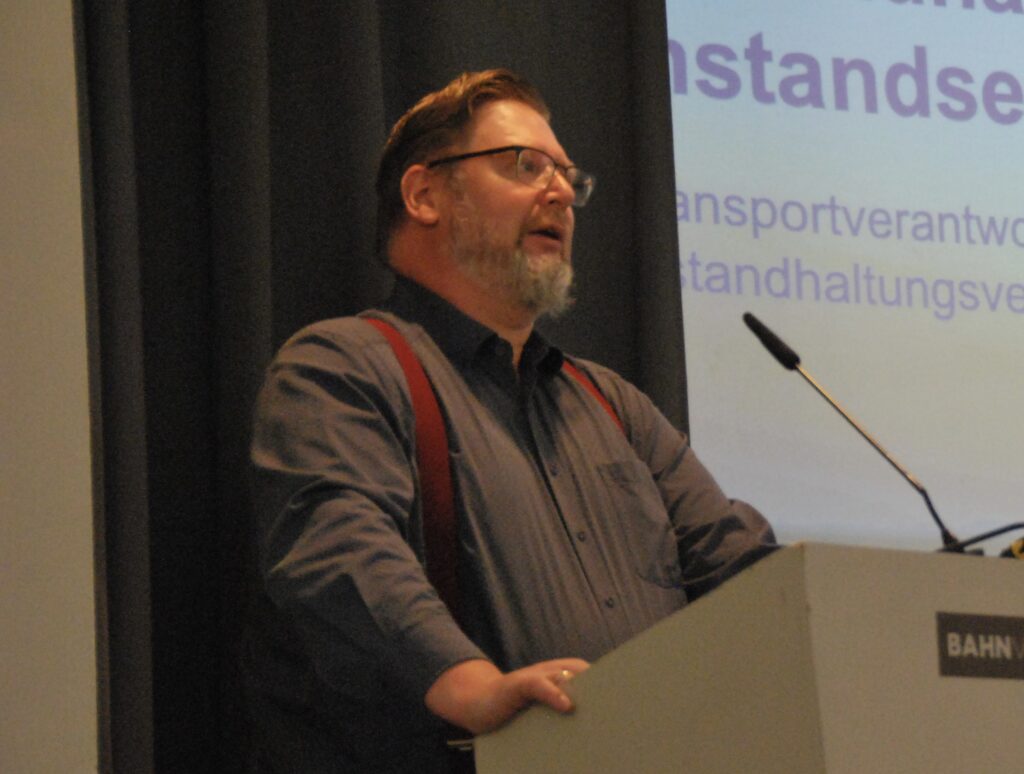
Nicolas Czernecki, Head of Wagons at Rail Logistics Europe
Twenty years after its introduction, the General Contract of Use for Wagons (GCU) has become indispensable to European rail freight. But is it still fit for purpose? Nicolas Czernecki, Head of Wagons at Rail Logistics Europe Groupe SNCF (RLE) and chair of the UIC Wagon User Study Group, believes the GCU needs more than technical adjustments. In this interview, he calls for clearer responsibilities between railway undertakings (RUs), keepers and entities in charge of maintenance (ECMs), a review of liability rules and a more professional GCU organisation. In this interview with BahnVerstand, he outlines RLE's vision for GCU 2030+.
---
BahnVerstand: Nicolas, the GCU celebrates its 20th anniversary in 2026. Has it been a success story?
Nicolas Czernecki: In many respects, yes. The GCU is no longer a child, but I would hesitate to call it fully grown up. However, on some topics, it has already become rather old.
Its greatest achievement is the efficient daily management of damaged wagons across Europe. Appendix 4 provides a common framework for damage reporting, Appendix 9 establishes uniform damage coding, and Appendix 12 regulates liability for damage to wagons.
I would particularly highlight Appendix 10, which allows RUs to restore a wagon's fitness to run without unnecessarily complicated procedures. This saves time and money. In my view, it is the GCU's most valuable appendix.
However, the GCU still carries historical baggage. Its underlying philosophy often reflects the former national railway monopolies mindset rather than today's European railway market.
Where do you see the most serious weaknesses?
First, the division of responsibilities between RUs, keepers and ECMs is not sufficiently clear, particularly when it comes to pre departure checks and maintenance decisions.
Second, Article 27, governing liability for damage caused by wagons, raises fundamental questions.
Third, governance and amendment procedures are outdated. Some signatories also apply the contract selectively or pay insufficient attention to their obligations.
Finally, digitization is progressing far too slowly and the signatory support to the GCU Broker is far behind the expectations of today's railway sector.
Appendix 9 has been the subject of considerable discussion. What would Rail Logistics Europe like to change?
We have already made major progress by separating train exchange procedures from Appendix 9 and transferring them to ATTI alongside with the issuing of a new UIC International Railway Standard. But further clarifications are needed.
Appendix 9 should primarily classify detected anomalies and define corresponding follow-up measures. It should not be treated as a mandatory checklist for pre departure inspections. This has not become clear enough yet despite the updated art. 12 in the 2026 GCU version. We should also reconsider certain defect codes, remove class 7 defects and anomalies from Appendix 9, simplify specific examination requirements following exceptional events and review the existing labels.
My broader concern is that ECMs rely too heavily on Appendix 9 instead of fully exercising their own responsibilities. Some provisions in Appendix 9 still reflect practices established by railway monopolies 50 years ago.
You also propose revising Article 12 on pre departure checks. Why is this important?
We need a perfectly shared common understanding of what a RU is actually required to do during its pre departure operations. What is the purpose and status of those operations ? Which immediate measures must or can be taken by the RUs ? Which are maintenance tasks and which are operational tasks ?
According to the texts in force, pre departure checks performed by RUs are strictly level 1 maintenance operations to detect visible and obvious anomalies on wagons that are supposed to be in a safe condition to run according to the ECM regulation. Nothing less, but nothing more. Exactly the same thing as an airplane pilot walking around his aircraft before takeoff, or a truck driver inspecting their vehicle before driving.
No one can seriously think that RUs performing a pre departure checks verifies that each and any one of the wagons incorporated in its trains is free from all the 380 anomaly codes listed in Appendix 9. RUs are not responsible to ensure through their operational checks the perfect condition of the wagons provided by the keepers, but only to verify the absence of visible anomalies through fast ground staff inspections. That shall be clear in wording of the article 12, which is not completely the case today and may unfortunately lead to misunderstandings between keepers and RUs.
We also need clarity about how these activities relate to the RU's safety certificate or to maintenance activities. When does responsibility lie on the RU or remain with the keeper or ECM ? In other words, we must clearly separate in article 12 and Appendix 9 which remediations are linked to operations and therefore mandatory for the railway undertakings as full part of their “job” and which remediations are maintenance linked operations belonging to the scope of the ECM.
Obviously, a RU can always perform such maintenance remediations during their pre departure checks, but only on a voluntary basis if it has the competences and the will to perform them. Today, those questions are not always answered consistently. The GCU, ECM Regulation and TSI OPE must be better aligned so that each party can fulfil its safety responsibilities efficiently.
Another sensitive aspect of GCU - even more after the Gotthard Base Tunnel accident - is Article 27 and keeper liability. RLE proposes a fundamental change in the liability regime. What are your ideas on that?
Under the current GCU liability regime, the keeper is liable only on the basis of a proven fault. We consider this particularly problematic when damages result from latent or hidden defect of a wagon.
Compare this with the relationship between RUs and infrastructure managers under the CUI rules, where strict liability applies between both actors.
Why should the position of wagon keepers be fundamentally different, especially given their obligations under the ECM Regulation and Railway Safety Directive ?
We believe the current liability approach needs to be reconsidered. Strict liability for keepers, as it was under the RIV before the liberalization in 2006, is one possible solution favored by Rail Logistics Europe and other RUs in Europe; but different options are on the table still. Insurance arrangements could also form part of a balanced solution.
Significant changes have already been adopted for 2026. More changes are under way for 2027. How do you assess the recent changes in GCU main contract: are these steps in the right direction?
Absolutely. The modularisation of Appendix 10 and the simplification of Appendix 9 were important steps. I also particularly welcome the substantial revisions to operative maintenance procedures, especially Article 19, taking effect in 2026 and also in the 2027 GCU version to come soon. They better align the GCU with the regulatory framework for ECMs.
However, these improvements are not the end of the process. They show that modernisation is possible, and we should continue to build on that momentum.
Let us finally put some light on the governance issue of GCU. Do you see the need of changing the GCU governance model and where?
Yes. The existing three-college voting system in the GCU — “pure” RUs, “pure” keepers and RUs that are also keepers — does not reflect anymore today's market structure with 850 signatories. Today, I think that two colleges, one representing RUs and one keepers, might be considered as more appropriate to address efficiently the topics the sector is facing.
Put also into account the somewhat poor degree of signatory-representation achieved by the the three sector associations. We have more and more signatories that are not associated with any of the three associations. And this growing number of signatories is not involved in the early stage of the amendment process.
Finally we could think about developing the GCU organisation into a professional set up, that drives digitalization forward, further develops the GCU Broker functionalities and usage and possibly integrates a European maintenance guide into a broader range of services.
Finally, what would you like the GCU to look like in 2030 and beyond?
I would like to see a contract that reflects today's European railway sector rather than yesterday's structures. A contract with clear responsibilities, modern liability provisions, effective digital tools and governance that encourages genuine participation.
Today, signatories pay very small fees, contribute relatively little and receive few services. I would describe that as a lose-lose situation.
We should aim for the opposite: a GCU that delivers tangible value and gives signatories good reasons to play an active role in its development.
The GCU has proved the value of a common European framework. Now we need to make it fit for the decades ahead.
Nicolas, thank you for this interview.